

Damascus steel is the most misunderstand word in knife marketing. It is sold as an ancient super-steel, priced like jewellery, and defended in forums with claims that no metallurgist would sign. Here is what the pattern on the blade actually is, what it does, and how to tell real layering from a laser-etched imitation.
Two different things share the name
Historic Damascus, more accurately wootz, was a crucible steel made in South Asia and the Middle East. It was cast, slowly cooled to form carbide bands, then forged. The banding came from the chemistry of the melt. That process died out; nobody has reproduced it at scale with certainty.
Modern Damascus is pattern welding: two or more steels with different compositions, stacked, forge-welded into a billet, then folded, drawn out and manipulated until the layers are thin and visible. The blade you buy today with a swirling pattern is almost certainly this, and it is a legitimate craft – it is just not the historical metal.
The distinction matters commercially: a modern pattern-welded knife can be excellent, but its quality comes from the steels chosen and the heat treatment, not from the pattern.
How the pattern is made
- Two steels are chosen with different nickel or carbon content – often a hard core steel and a softer contrast layer.
- They are stacked, fluxed and forge-welded at high temperature into a solid billet.
- The billet is folded, drawn, twisted or cut and restacked. Each operation multiplies the layer count.
- The blade is ground thin enough that the layers sit near the surface.
- Acid etching bites the softer, lower-nickel layers faster, so the pattern appears as relief.
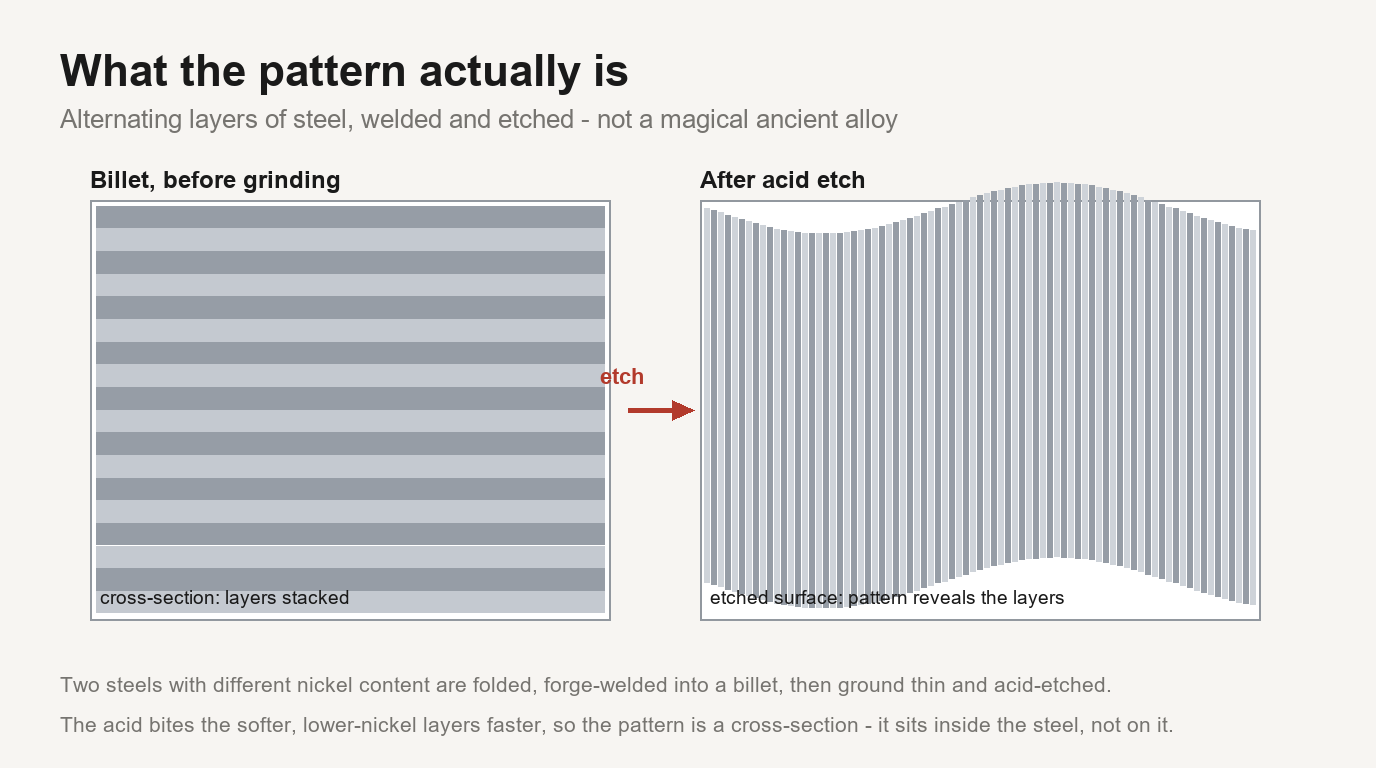
The last step is why the pattern is a cross-section, not a coating. Etching removes a few microns from the surface of one layer faster than another, and the height difference scatters light. Polish it away and the pattern fades; re-etch it and the pattern returns.
What the pattern tells you, and what it does not
It tells you the maker can forge-weld cleanly. A pattern with no dark voids, no visible weld lines and no delamination is evidence of competent work – forge welding is the hard part of the craft, and a bad weld fails in use.
It does not tell you the blade will hold an edge better than a mono-steel knife. In most modern Damascus the cutting performance comes from a hard monosteel core, with the patterned layers cladding the sides for looks and some toughness. Compare a patterned knife with a well-heat-treated plain blade at the same hardness and the edge retention is comparable.
Where layering genuinely helps is toughness: alternating ductile and hard layers resist crack propagation better than one homogeneous slab. That is a real benefit on large choppers. On a 20 cm kitchen knife it is marginal.
The number that actually predicts performance is hardness and heat treatment – see knife steel and hardness. A 62 HRC core with a tight grain structure will out-cut a 58 HRC Damascus blade every time, whatever the pattern looks like.
Real layering vs laser-etched fake
Cheap “Damascus” is frequently a single piece of stainless with a pattern printed or laser-etched onto the surface. Three checks separate them:
- Look at the spine and the choil. Genuine layering continues around the spine and into the unsharpened ricasso. A printed pattern stops at the flat.
- Feel it. An etched pattern has a slight relief you can feel with a fingernail. A printed one is glassy.
- Look at the edge bevel. On a clad blade the core steel shows as a thin bright line along the very edge. A fake shows the same pattern right to the apex.
A fourth check is price. Genuine pattern-welded blades take hours of forge time; if the price is closer to a stamped supermarket knife, the pattern is decoration.
Living with a Damascus blade
The layers are different steels, so they corrode at different rates. That is why a Damascus blade develops a mottled patina quickly and why it needs more attention than a plain stainless knife.
- Dry it immediately after washing; never leave it wet in a sink or a rack.
- Oil the blade lightly if it will sit unused – see knife maintenance.
- Expect the etch to soften with use and cleaning. A re-etch with ferric chloride restores contrast if you care about it.
- Do not put it in a dishwasher. Heat, detergent and long wet cycles are exactly what the layer boundaries dislike.
Sharpening is normal: treat it as the steel it is, and follow the stone sequence. If the blade has a hard core, a 15-17 degree edge is right for most kitchen use.
Should you buy one
Buy it because you like the object. That is a legitimate reason – a knife you enjoy using gets used more, and gets maintained better. What you should not do is pay a premium expecting measurably better cutting than a well-made plain carbon or stainless blade at the same hardness.
If you want the contrast of carbon and stainless in one blade without the maintenance, a san-mai construction – a hard core clad in softer stainless – gives you most of the toughness benefit with far less rust risk. The trade-off between the two families is covered in carbon versus stainless.
What the pattern costs you
Pattern welding adds labour, not performance. A maker spends hours stacking, welding and manipulating a billet before a blade exists, and layer counts in the hundreds are as much a craft statement as a metallurgical one. That cost is real, and it is why honest patterned knives start well above the price of a comparable mono-steel blade.
The practical question is what you get for the premium: a forged object with visible craft, a slightly tougher cross-section, and more maintenance. What you do not get is a sharper or longer-lasting edge than a well-treated plain blade at the same hardness. Buyers who understand that tend to be happier with the knife than buyers who were told it would out-cut everything.
Frequently asked questions
Is Damascus steel stronger than normal steel?
No. Its advantage is toughness – alternating hard and ductile layers resist cracking – and its pattern is mostly aesthetic. Edge holding depends on the core steel and its heat treatment.
Does the pattern wear off?
The etch fades with polishing and washing, but the layers do not disappear. Re-etching with acid restores the contrast because the pattern runs through the steel.
How can I tell fake Damascus from real?
Check the spine and choil – real layering continues around the metal. Feel for slight relief, and look for a bright core line along the edge bevel. A pattern that stops at the flat is printed or laser-etched.
Is modern Damascus the same as historical Damascus?
No. Historical Damascus was wootz, a crucible steel whose banding came from its chemistry. Modern Damascus is pattern-welded from stacked steels. Both are real, different things.
Can Damascus knives go in the dishwasher?
No. The layer boundaries corrode at different rates and dishwasher cycles leave water in places a towel cannot reach. Hand wash and dry immediately.
Sources
Background on the historical steel, the modern technique and the distinction between them: Damascus steel, pattern welding, and wootz steel.