

A serrated knife is not a knife with a wavy edge. It is a row of small, hardened points, each with its own bevel, and each cutting on the push or pull rather than on the slice. That is why a bread knife stays useful long after a chef’s knife needs work – and why most attempts to sharpen one ruin it.
Drag a serrated blade across a flat stone and the stone never reaches the points. It grinds the scallops down until the edge is a shallow wave. The knife still cuts, badly, and tears everything it touches.
What is actually dull on a serrated knife
The tips of the scallops. They take the load on every stroke and round over first. The sides of each scallop rarely touch food, so they stay sharp for years.
That means you are not restoring a single continuous edge. You are restoring a sequence of tiny ones, and each needs the same angle it had when it left the factory.
The tool that works
A tapering rod: a serrated sharpener, a round diamond file, or the fine side of a honing rod. It has to be narrow enough to sit inside one scallop without touching its neighbours.
A flat stone is the wrong tool here, however good it is on a straight edge. This is one of the few places where a rod beats a stone outright, and it is the reason sharpeners and rods both earn a place in a kitchen.
Sharpening one scallop at a time
- Hold the knife edge-up and steady it against a board or your knee.
- Fit the rod into the first scallop, resting it flat against the bevel that is already there.
- Take three or four light strokes, following the existing angle. Do not invent a new one.
- Move to the next scallop and repeat, working along the blade.
- Check the points against a thumbnail: they should catch, not slide.
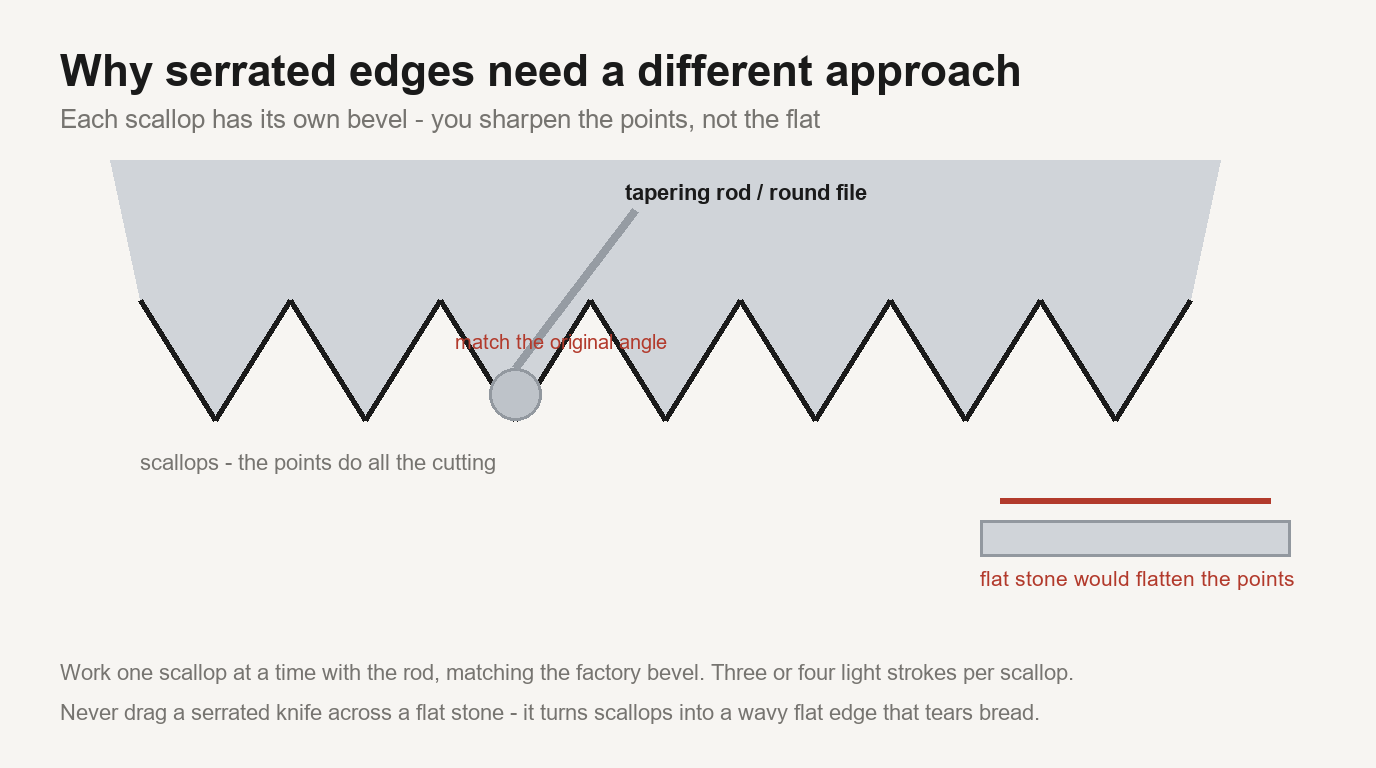
The angle matters as much here as on a straight edge. A scallop sharpened steeper than its neighbours will sit proud of the row and catch on the board instead of the crust. Edge geometry explains why the original bevel is worth preserving rather than improving.
What not to do
- Do not use a pull-through sharpener. It cuts a V across the points and turns scallops into a saw-toothed mess.
- Do not flatten the edge on a stone first. That is the damage, not the repair.
- Do not sharpen the flat side. Serrated knives are ground on one face; working the flat face removes the set of the teeth.
- Do not press hard. The points are thin and brittle, and pressure snaps them off.
When to replace instead
Bread knives are often cheaper to replace than to restore. If the points have been rounded flat by a pull-through, if teeth are missing, or if the blade has been run through a dishwasher until the edge corroded, a new knife is the honest answer.
For a knife worth keeping, sharpening takes ten minutes and the result is a blade that bites into crust instead of crushing it. A straight kitchen knife follows the same logic with a different tool – see how to sharpen a knife with a stone for that sequence.
Keeping it sharp between sessions
Serrated knives should not be honed. A rod rolled along the scallops rounds them. Store the knife so the teeth touch nothing, cut on wood or plastic rather than glass, and hand wash it. That alone keeps a bread knife working for years.
Which serrated knives are worth the effort
Not all of them. A ten-dollar bread knife with stamped teeth and a hollow plastic handle is a disposable tool; sharpening it costs more attention than it deserves. A forged serrated knife with a full tang and a blade that has stayed straight is worth ten minutes twice a year.
The test is simple. Look along the blade with a light behind it. If the points still stand in a straight row and the scallops are deep and even, sharpen it. If the row wanders, if teeth are chipped, or if the blade flexes visibly in the handle, replace it.
Two other categories behave differently and are usually not worth sharpening at all: tomato knives with very fine micro-serrations, which cannot be restored by hand, and cheap steak knives, which are serrated precisely so they never need it once.
How to tell whether it worked
Do not test on your thumb. Serrated points bite deeply before they slip, and the cost of being wrong is a deep cut.
- The paper test. A serrated blade should start a cut on printer paper without pressure and pull through cleanly. Tearing, rather than slicing, means the points are still rounded.
- The crust test. A ripe tomato or a crusty loaf is the honest test. The knife should bite in on the first stroke rather than skidding across the surface.
- The light test. Hold the blade edge-up under a lamp. A restored edge shows a row of bright points; a dull one shows a continuous gleam where light reflects off rounded metal.
If the knife fails all three after ten minutes of work, the teeth were worn past the point where the bevel can be re-established. That is a replacement, not a failure of technique.
The two-minute version
If you take nothing else from this: rod in the scallop, follow the existing angle, three or four light strokes, move on. Never the flat stone, never the pull-through, never the dishwasher. That is the entire method, and it is why a bread knife that is looked after outlasts the chef’s knife beside it.
Frequently asked questions
Can you sharpen a serrated knife on a whetstone?
No, not effectively. A flat stone cannot reach inside the scallops and instead grinds the points down. Use a tapering rod or round file that fits one scallop at a time.
How often should a serrated knife be sharpened?
Once or twice a year in home use. Serrated edges stay sharp longer than straight edges because the points protect each other, and they take far less cutting load.
Should I hone a serrated knife?
No. A honing rod rounds the scallops rather than realigning them. Serrated knives need sharpening at the points, not honing.
Why does my bread knife tear instead of slice?
The points are rounded, usually from a pull-through sharpener, a dishwasher cycle, or years of cutting on glass. Restoring each scallop with a rod usually fixes it.
Sources
Background on edge geometry and bevel maintenance: Knife sharpening. Manufacturer guidance on abrasive selection: Shapton.